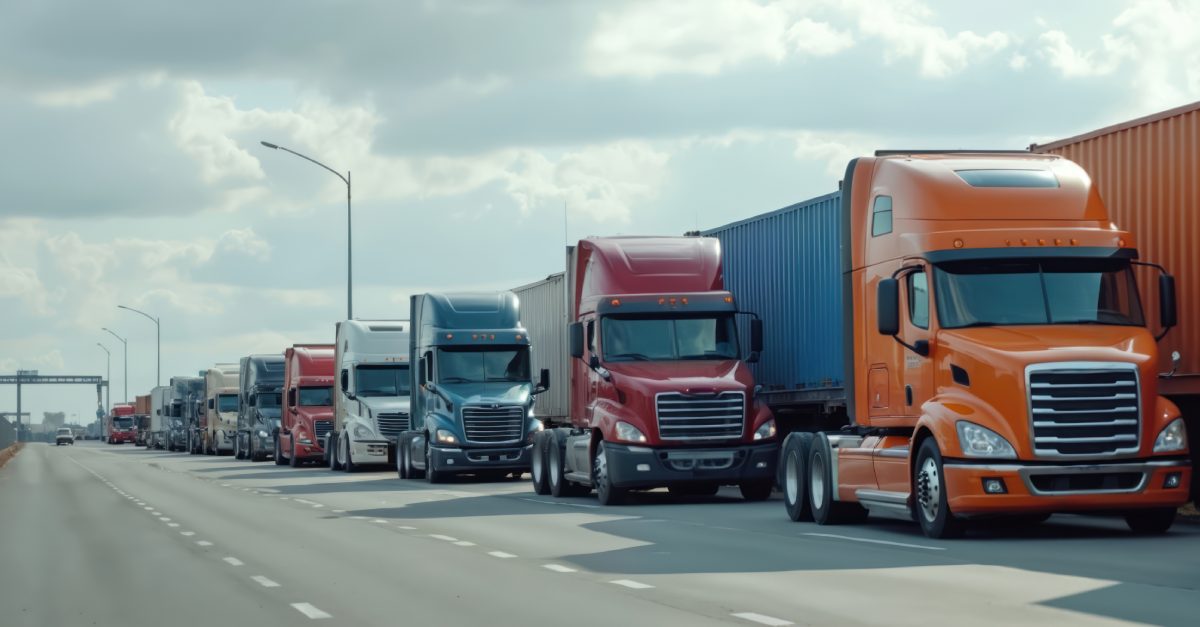





Harsh winter storms and a shortened holiday shopping window have triggered short-term rate surges, while long-term challenges such as emissions rule uncertainty, capital constraints, and shifting sourcing patterns are reshaping freight flows and purchasing behavior. This month’s news roundup focuses on that volatility, from plummeting Class 8 truck orders to spiking Midwest spot rates.
We also track how veteran hiring efforts, shifts in global trade, and financing tools are helping companies adapt. Whether you’re managing capacity, adjusting sourcing, or planning equipment purchases for 2026, this is a critical snapshot of where the freight market stands and where it’s headed.
Winter Disruptions and Shorter Shopping Season Drive Truckload Rates Up
Spot rates across the 50 largest U.S. lanes jumped 4% in early December, driven by snowstorms and a compressed holiday shopping season. According to DAT Freight & Analytics, it’s the sharpest early December increase in over five years. Wisconsin saw a 19 cents-per-mile spike, while Midwest rates surged 23% week over week.
High-demand short-haul routes, such as Allentown to Boston, rose by as much as 30 cents. While carriers view this as seasonal, Werner Enterprises CEO Derek Leathers said shippers are already looking to “derisk” by securing contract rates earlier. Nevertheless, contract rate increases remain modest, typically below 5%.
ATA Pushes Lawmakers to Strengthen Veteran-to-Trucker Pipelines
The American Trucking Associations has urged Congress to bolster programs helping veterans transition into trucking careers. Testifying before the House Veterans’ Affairs Subcommittee, Werner Enterprises’ Greg Hamm pushed for increased CDL training funds and support for the Warriors to Workforce Act and the Veterans’ Transition to Trucking Act. About 20% of Werner’s 13,000 employees have military ties, although the goal is 25%.
Hamm cited the discipline and leadership veterans bring, and called veteran hiring a sound business strategy, particularly amid industry challenges such as shrinking driver pools and new English-proficiency enforcement.
Tonnage Slumps as Spot Market Heats Up Post-Holiday
ATA’s October For-Hire Truck Tonnage Index showed a 2.1% decline, which is the sharpest monthly drop since January 2024. Year over year, tonnage fell 1.8%, reflecting weak demand and capacity oversupply, especially since post-Thanksgiving dry van activity has rebounded.
Load posts doubled, pushing the load-to-truck ratio to 10.48, while spot rates rose 7 cents to $1.81 per mile nationally, and Midwest lanes jumped 13 cents to $2.10 — 29 cents above the national average. Meanwhile, DAT’s top 50 lanes averaged $2.13 per mile. These figures clearly illustrate the tension between stagnant contract freight and a heating spot market, particularly in regions with dense short-haul retail flows.
Class 8 Truck Orders Plummet as Fleets Hold Back Amid Profit Squeeze
Class 8 truck orders collapsed in November, down 47% year over year to 19,700 units, according to ACT Research, far below the 10-year average of 28,910. Despite clearer EPA 2027 emissions guidelines, carriers remain reluctant to invest. Spot rates are still low, and freight demand remains soft.
Volvo’s Magnus Koeck called November the fourth weakest for orders since 2010. Mack Trucks noted that customers expect this downturn to last through mid-2026. Fleets are now focusing on equipment maintenance, cost control, and squeezing more value from existing assets rather than expanding capacity.
Tariffs Push Importers to Diversify and Seek Capital Relief
Supplier reliance on China, Hong Kong, and Korea has dropped from 90% to 50% over the last decade, according to Wells Fargo. Countries like Vietnam, Indonesia, and India are now key sourcing regions, with Vietnam-to-U.S. volumes up 23% year over year.
Even as a Supreme Court ruling could strike down tariffs, importers are already feeling the pain. Inventory front-loaded in early 2025 is nearly gone, and average tariff costs have jumped from 1.5% to double-digit levels. HSBC reports a 20% surge in trade finance demand as companies renegotiate payment terms. More than 70% of surveyed U.S. businesses report increased working capital needs.
Navigate the Freight Crisis With Wicker Parker Logistics
In times of supply chain uncertainty, having an expert partner at your side is essential — and that’s exactly what Wicker Parker Logistics delivers.
With decades of industry experience, advanced logistics and transportation technology, and a consultative approach, we provide on-demand transportation across FTL, LTL, flatbed, hot-shot, and reefer. Every shipment comes with full end-to-end visibility so you can track progress in real time and act with confidence.
Contact us for a quick quote today.